
June 2026 Update & Giving Allocations
Donors and Alumni,
As we wrap up our sixth giving cycle, we are pleased to be working on several exciting new initiatives. This past year, we have been collaborating with the Canfield family, friends and major donors to UT Austin’s business program, to direct their foundation’s giving. This represents an important opportunity for leverage on our philanthropic diligence as well as learning for our students. In our newsletter next month, we’ll share details on the outcomes of these efforts, opportunities to engage within the Giving Committee, and learnings from this year.
The main purpose of this letter is to share the Giving Committee’s recommended charity giving allocations for the 2025-2026 giving cycle. For those participating in the Giving Pledge, expect an email from Harvey Powers or Ariel Johnson in the upcoming week with specific instructions on completing your giving and directing your personal allocations.
We recognize that there are many areas of need that merit our attention, resources, and political participation. As a reminder, the USIT Foundation supports apolitical, domestic charities with which we have had repeated points of contact for at least one year. These are locally-led, high-quality organizations that we believe are generating high impact (gauged by dollars of social good created for every dollar donated).
This year, the Giving Committee’s recommended allocations are as follows:
Providence House (28%, economic mobility, family reunification)
Valley Initiative for Development and Advancement (20%, economic mobility, job placement)
Prison Entrepreneurship Program (19%, recidivism, entrepreneurship)
The Televerde Foundation (18%, recidivism, workforce readiness)
Any Baby Can (15%, healthcare, early childhood intervention)
More details, including links to the Philanthropy Investment Team’s work product, on these charities are included below. Our work this year included a review of substantially all donation candidates from prior years. Notably, Rehabilitation Enables Dreams, a major previous recipient of USIT Foundation funding, is converting to a for-profit model to seek subscription revenue from counties for their recidivism-reduction program, a much more stable funding mechanism than variable donations.
The USIT Foundation has donated over $500,000 (!) since inception, details below.
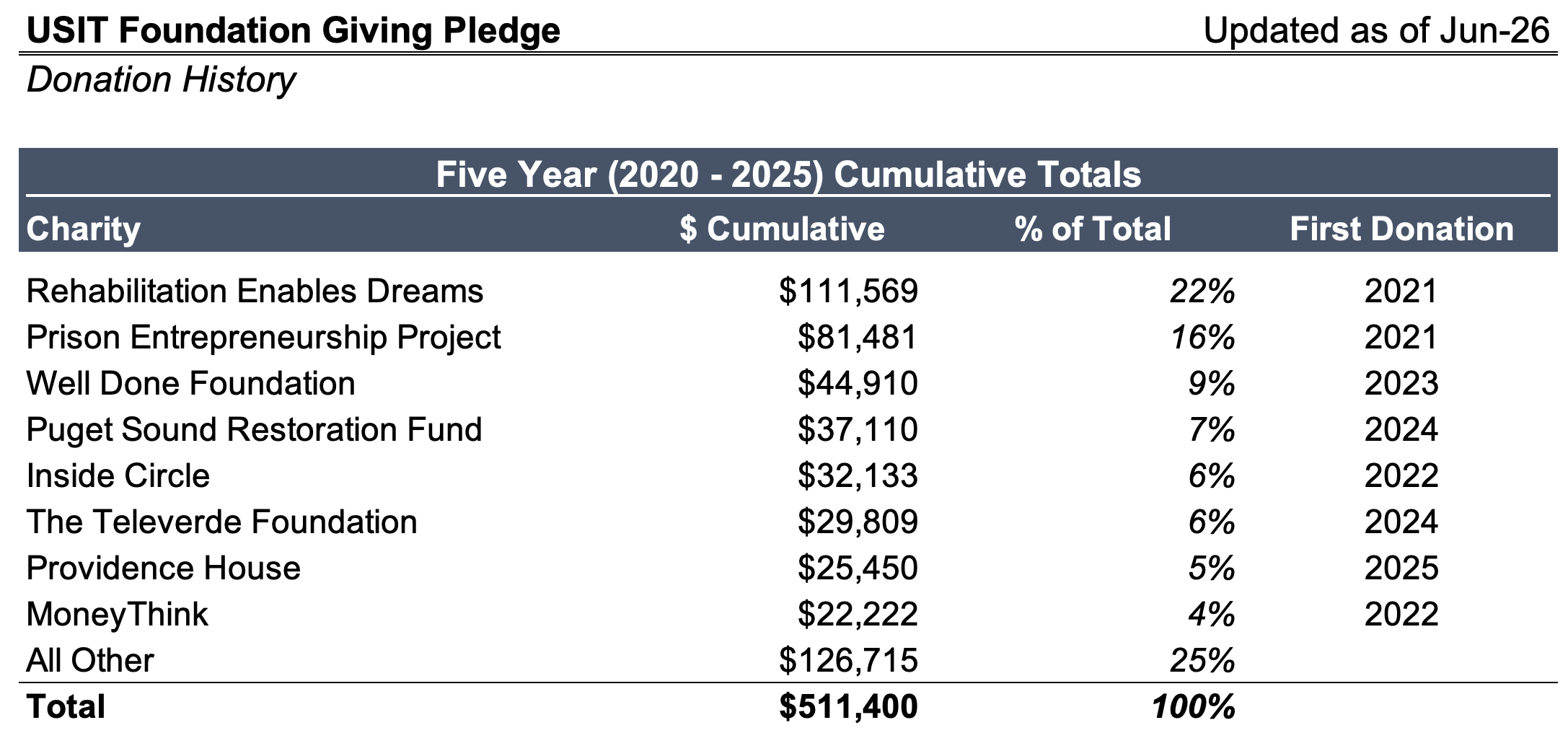
As always, we are honored by your participation and interest. Please reach out with any questions.
Best,
Angela Yang
2025-2026 Chairperson of the USIT Foundation Giving Committee
2026 Summer Intern and Executive Director
***
2025-2026 Giving Committee Allocation Recommendations
Providence House (28%) [2026 Portfolio Update]
Economic mobility, family reunification
Providence House (PH) is a $6M, Ohio-based charity providing crisis nursery and parent rehabilitation services for child abuse prevention and family preservation. PH provides free (i) emergency shelter to children who are actively living in crisis situations and (ii) support services to their families. Over the past five years, PH has achieved a reunification rate of 99% (meaning that 99% of families in crisis stay together, instead of being separated by the child welfare system), compared to the national average reunification rate of 50% after foster care. Children stay in PH’s crisis nursery for an average of 33 days and are provided with a safe, home-like environment. During this period and for 12 months after the crisis is resolved, guardians participate in a Family Preservation Plan to establish longer-term family stability. In 2025, Providence House served 214 children in its crisis nursery, with 340 children on its waitlist. Households that participate in programming experience an increase in household income of 25% and longitudinal benefits of housing stability and employment attainment.
The USIT Foundation donated $25,450 to Providence House in 2025. One of our analysts, Joyce Lin (and future Director of Philanthropy), has been interning for the charity over the past year.
Valley Initiative for Development and Advancement (20%) [2026 Underwriting Presentation]
First-time donation candidate; economic mobility, job placement
The Valley Initiative for Development and Advancement (VIDA) is a $4M, Rio Grande Valley-based workforce development charity focused on providing educational and vocational assistance in high-demand fields to students from nontraditional backgrounds (cohort average age of 27, majority low income and underemployed, 95% acceptance rates into VIDA programming). By guiding participants toward career paths that are both high-paying and in-demand (e.g., nursing, computer science, specialized trades) and leveraging a diverse employer network, VIDA achieves 83% graduation rates (vs. 29% for comparable students at UT Rio Grande Valley) and $42K average wage growth (+375%) for participants.
Prison Entrepreneurship Program (19%) [2026 Portfolio Update]
Recidivism, entrepreneurship
Prison Entrepreneurship Program (PEP) is a $5M, Texas-based charity, having served 3,450 graduates since its founding in 2004 and achieving 100% graduate employment rates, <10% cumulative recidivism rates (vs. 50% nationally), and $10K annual programming expenses (vs. $30K Texas cost to incarcerate) per graduate. PEP graduates have created 700+ businesses, generating $125M of economic impact, supported by an in-house accelerator and venture fund. In 2025, PEP successfully scaled its Leadership Academy Correspondence Course, an innovative tablet-based digital program, to all 102 Texas Department of Criminal Justice (TDCJ) prisons, and 3,200 inmates completed the program (expected to reach 130,000 inmates over the next 20 years). Future growth levers include physical expansion to three more prisons in 2026, national replication, increased housing capacity, and entrepreneurship curriculum development. Our thesis is anchored in our alignment with PEP's novel theory of change in delivering sustained, transformative outcomes to a hard-to-serve demographic (i.e., incarcerated individuals) using finance and entrepreneurship.
The USIT Foundation has donated $81,481 to PEP cumulatively (2021-2025).
The Televerde Foundation (18%) [2026 Portfolio Update]
Recidivism, workforce readiness
The Televerde Foundation is a $3M, Arizona and Indiana-based charity that offers workforce development, employment (across four career tracks), and educational (in partnership with local public universities) programming to incarcerated women. Televerde has maintained a remarkable <3% all-time graduate recidivism rate over its six years of operation across 821 graduates. In 2025, the charity achieved an 86% employment rate upon graduation with a $38K average starting salary for participants. Management is currently working on standardizing its programming methodology to facilitate physical expansion with the assistance of researchers at the University of Notre Dame.
The USIT Foundation has donated $29,809 to Televerde cumulatively (2024-2025).
Any Baby Can (15%) [2026 Underwriting Presentation]
First-time donation candidate; healthcare; early childhood intervention
Any Baby Can (ABC) is a $15M, Austin-based charity providing early childhood healthcare interventions that address the root causes of developmental and family instability during the highest impact window (pregnancy through early childhood). Through three integrated programs – Nurse-Family Partnership (prenatal/postpartum care), Early Childhood Intervention (developmental therapy), and Family Education – ABC serves 3,200 low-income families annually. The charity operates as the sole NFP provider in Travis and Williamson Counties and is the primary ECI provider across 75% of Travis County, with 99% of parents reporting increased confidence in caring for their child. These early interventions have been causally shown to improve child health and school readiness, reducing maltreatment by 42% and healthcare encounters by 23%. State-run Texas ECI programs are severely under-resourced with long waitlists and cost $5-7K per person served, compared to ABC’s $4.5K per person served.
Our ABC underwriting was one of three projects conducted in collaboration with the Canfield family.